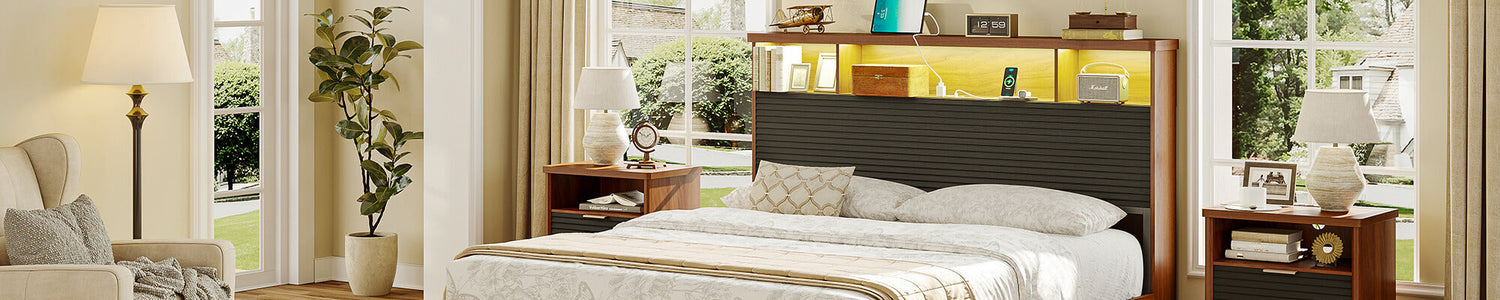

Do LED Bed Lights Ruin Your Sleep? Here's the Science
No — LED light itself is not the enemy of sleep. The bedroom lighting that measurably delays sleep is short-wavelength light (blue-cyan, peaking near 480 nm) delivered brightly into your eyes during the last one to three hours before bed. A dim, warm, indirect strip bouncing off a wall — which is how most headboard and under-bed lights are installed — delivers a fraction of that signal, often less than the phone you scroll at arm's length. Put another way: geometry and spectrum matter more than the word on the box.
Walk into any lighting aisle and the message is blunt: blue light is bad, warm light is good, buy the amber bulb. That rule of thumb is mostly right, but it hides the part that actually decides whether your bedroom lighting helps or hurts. Light acts on your body clock through a dose — spectrum times intensity times duration times whether the beam hits your pupil directly. Miss any one of those and you either panic about nothing or miss the thing that's really costing you sleep.
Why LED got the blame — and why the reputation is only half deserved
White LEDs don't emit "white" light directly. Most are a blue-emitting diode covered in a phosphor coating that converts part of that blue energy into longer wavelengths. The result is a spectrum with a pronounced hump in the short-wavelength region, somewhere between 450 and 480 nm even for bulbs sold as warm white. That hump is exactly the region your body clock reads most carefully.
So the criticism has a real basis. But three things are usually left out of the conversation:
- Cool white has existed without LEDs. Any bright white light — halogen, fluorescent, daylight through a window — carries the same short-wavelength signal. LEDs just made it cheap, dimmable and easy to install everywhere, including furniture.
- Distance does more than colour. Illuminance falls off roughly with the square of distance. Halve the distance to a source and you quadruple its brightness at your eye. A phone at 12 inches hits the retina far harder than a strip on the far side of the room, whatever colour either one is.
- Direction is underrated. A light source you cannot see directly — one tucked behind a headboard panel, under a bed rail, or beneath a cabinet edge — reaches your eye only after bouncing off a surface, and every bounce costs you most of the intensity.
That third point is why the question "are LED bed lights bad for sleep?" doesn't have the simple answer the internet prefers. It depends what the light is aimed at.
The three-minute biology bit
Beyond the rods and cones that build images, your retina contains a small population of intrinsically photosensitive retinal ganglion cells. They contain a photopigment called melanopsin, and they don't care much about picture-forming vision. Their job is to report ambient light level to the suprachiasmatic nucleus — the brain's master clock — which then signals the pineal gland about melatonin.
Melanopsin sensitivity peaks around 480 nm, which reads as blue-turquoise. The response is dose-dependent: brighter light and longer exposure suppress melatonin more and shift circadian timing further, and dim light of the same colour does measurably less. Evening light also slows the natural drop in core body temperature that normally opens the sleep gate, so the effect isn't limited to melatonin alone.
The practical consequence: you don't have to live in the dark, you have to manage the dose.
The three knobs that decide everything
Colour
Correlated colour temperature (measured in Kelvin) tells you how much short-wavelength energy is in the beam. Lower is warmer and gentler on the clock. Below about 2700K you are in comfortable territory for evening use.
Quantity
What matters is the light arriving at your eye, not the output of the fixture. A 400-lumen strip bouncing off a dark wall can land dimmer than a 40-lumen lamp pointed at your face. This is the knob people forget entirely.
Timing
Your clock is most sensitive in the hours before your usual bedtime and in the first hours after you wake. The same light at 6 pm and at 11 pm are not the same event as far as your body is concerned.
Colour temperature, quantified
Researchers describe non-visual light effects using melanopic quantities defined in the CIE S 026 standard. You don't need the maths. The chart below shows relative melanopic stimulation for common white light temperatures at the same perceived brightness, normalised so that a familiar warm white 2700K equals 100.
Values are indicative. Real figures shift with the specific diode bin, phosphor mix and CRI, sometimes by a wide margin. The trend is what matters: dropping from 5000K to 2200K cuts the signal to roughly a fifth.
How bright is too bright? Use a lux ladder
Most people have no intuition for brightness numbers, so it helps to anchor them. Lux measures light landing on a surface; the numbers below are approximate vertical illuminance at eye level, which is the relevant figure for your body clock.
| Situation | Approx. lux at the eye | What it means before bed |
|---|---|---|
| Full moon, clear night | 0.1 – 0.3 | Irrelevant to your clock, and enough to find your way |
| Dim amber pathway light | 1 – 5 | The sweet spot for night-time bathroom trips |
| Practical pre-sleep ceiling | ~10 | Warm light at this level produces little measurable suppression |
| Phone screen at arm's length | 30 – 80 | Comparable to a dim room, and pointed straight at your eyes |
| Typical living room, evening | 80 – 150 | Enough to delay the clock if sustained late into the evening |
| Indirect strip on a light-coloured wall | 5 – 30 | Depends entirely on reflectance and where the strip points |
| Bright overhead after sunset | 300 – 500 | The classic mistake — bright white overheads until lights-out |
Read that table once and the strategy writes itself. You are trying to move down it as the evening progresses, and to avoid the top row right up until you actually close your eyes.
Why light tucked behind furniture behaves differently
Here is the part that rarely gets explained, and it is the reason an LED feature on a bed frame or cabinet is not automatically a sleep hazard.
A decorative strip is usually a few hundred lumens per metre. Installed behind a headboard panel or under a bed rail, none of those lumens travel directly to your pupil. The light leaves sideways, strikes a wall or floor, and only the reflected portion comes back toward you. Typical light-coloured interior paint reflects somewhere around half to four-fifths of the visible light hitting it; a dark accent wall reflects far less, sometimes below a fifth.
Then geometry takes another slice: reflected light spreads over a hemisphere, so the amount arriving at your pillow is small even when the strip itself looks bright in a photo. In practice, an indirect warm strip set low usually lands in the single digits at eye height — inside or near the practical pre-sleep target.
Compare that with a reading lamp aimed at your face, or a screen you hold twelve inches away. Same room, same wattage ballpark, wildly different dose. Indirect light pointed away from where you sleep is one of the gentlest ways to keep a bedroom usable after dark.
If you're choosing hardware with that property in mind, an upholstered headboard that washes light upward behind its own panel keeps the source out of your sightline in a way a bare strip on the wall does not.
The advantage disappears the moment the light points at you. A strip mounted under a headboard that faces the pillow, a mirror-finish or glossy surface behind the source, or a bright cycle set to full output all undo the benefit. Check what the beam illuminates, not what the fixture says.
An evening protocol you can actually keep
Swap to lamp-height sources at roughly 3000K. You still want light for cooking and tidying — just not a ceiling full of it.
Everything on in the room drops to 2700K or warmer at no more than about a quarter brightness. Think aim-for-the-floor, not aim-for-the-ceiling.
If you read, light the page, not the room. Amber or warm white. Switch any colour-cycling mode off now rather than when you are already drowsy.
A steady amber or deep red, no motion sequencing. If your light has a timer, set it — falling asleep to a light that turns itself off beats one that doesn't.
A low amber path at a few lux gets you where you're going without resetting your clock or wrecking your night vision. This matters especially for older adults, where night-time falls are a genuine risk.
Bedrooms with built-in motion sensing or app scheduling make steps three and four automatic rather than something you have to remember when you are already tired. A bedside unit with its own dimmable light and a pull-out tray puts the last light of the night at knee height on the floor, which is closer to where you actually want it than a lamp at eye level.
Your RGB remote can undo all of this
Full-colour lighting is sold on possibility, and possibility is exactly what ruins sleepy lighting. Three settings are worth avoiding after dark:
- Music sync or sound-reactive mode. Every beat is a bright transient. Repeated flashes through your eyelids are not sleep-friendly, and rapid cycling is a known trigger for photosensitive conditions.
- Rainbow or gradient cycling. It sweeps through the cyan-blue region repeatedly, which is precisely the band you are trying to avoid.
- White at high output. Even "warm" white in RGB units often comes from mixing all three emitters at once, which is a different spectral recipe than a dedicated warm-white diode.
The fix is a boring one: pick a single colour near the red-orange end, set brightness to roughly ten to twenty percent, turn off every cycling and sound mode, and leave it there. Treat it as a setting you install once, the way you set a thermostat.
An RGB strip you can lock to one warm tone behaves like a night light; the same RGB strip on a dresser left cycling through sixteen million colours behaves like a bedroom disco. Same hardware, opposite outcome.
Who should be more careful than average
Light sensitivity is not uniform. Be stricter with the protocol above if any of these apply:
- Teenagers and anyone with delayed sleep phase. Adolescent clocks already run late; evening light pushes them later still.
- Shift workers sleeping during the day. Morning daylight after a night shift is a powerful signal. Blackout and zero light during the sleep window matter more than colour choice.
- Migraine. Light is a common trigger, and flicker — even imperceptible flicker from cheap dimming — can be a problem.
- Photosensitive epilepsy or a family history of it. Avoid colour-cycling and sound-reactive modes in a bedroom entirely, not just before bed.
- Anyone using light deliberately with a clinician. Bright morning light therapy is prescribed for seasonal depression and to reset circadian rhythm; if that's you, follow that protocol rather than this one.
The corollary is simple when you're buying anything new for a bedroom: check what you can control, then where the emitting face points. App or remote control with real dimming and the option to lock one static colour is worth paying for. Cycle-only hardware that defaults to a rotating demo mode is not, however pretty it looks in a showroom — including anything like a tall bedside tower with its own light strip that will sit lit beside you every single night.
The sixty-second bedroom light audit
- Lie down exactly as you sleep. Look around. Every source you can see directly is a candidate for dimming, moving or turning off.
- Count the sources above pillow height. Those are the worst offenders, and they are usually the ones left on.
- Set every bedroom light to its warmest setting and its lowest comfortable brightness. Note which ones don't offer either — those are the ones worth replacing.
- Check what each source actually illuminates. If it lights a wall or the floor and not your face, it is on your side.
- Set one timer or schedule so the last light of the night turns off by itself. Automation beats willpower at 11 pm.
Two other things worth building into the room itself. Putting the light below mattress level, so the beam never crosses your eyeline, is the single highest-leverage change you can make to a bedroom layout — which is why a low unit with the lit edge near its base, such as an open-shelf night stand that washes upward from a lower shelf, tends to work better next to a bed than a lamp on a tall dresser. And keeping the phone twenty inches away rather than twelve — because of that inverse-square relationship — costs less than any piece of equipment you could buy.
Frequently asked questions
Do LED strip lights affect melatonin?
Yes — any visible light can, including LEDs, and the effect scales with the dose. Melatonin suppression follows a dose-response curve: bright, blue-heavy light delivered straight into the eyes in the two to three hours before bed has the strongest effect, while dim warm light well below typical room levels produces little measurable suppression. Colour, brightness and proximity all count, which is why a dim indirect strip and a bright lamp drawn from the same technology behave completely differently.
What colour LED light helps you sleep?
The long-wavelength end: deep red, red-orange and amber, roughly 1800K to 2200K. These sit far from the 480 nm melanopic peak, so they deliver a weak signal to your body clock, and because your rod cells are largely blind to long wavelengths they preserve night vision as well. If you need something brighter to read by, a warm white at 2700K is a reasonable compromise as long as it is dim.
Is it safe to sleep with LED lights on all night?
There is no evidence that a very dim amber light harms a healthy adult's sleep, and for young children afraid of the dark or adults making night-time bathroom trips it is often the safer option. Sleeping with a bright white light on is a different matter — that dose, sustained all night, is more likely to fragment sleep and delay the clock. Rule of thumb: if it is bright enough to read by, it is too bright to sleep beside.
Red or amber — which is better for night-time?
Red is marginally gentler on your circadian signalling and preserves dark adaptation best, which is why astronomers and photographers use it. Amber is easier on the eyes for reading and generally feels less clinical. For a bedroom either works; pick red where you only need to see shapes, amber where you might glance at a clock or write something down.
Are RGB bed lights bad for your eyes?
At the low output these strips run at, there is no established risk to eye health from steady light. The real concern is dynamic behaviour: rapid flicker, strobe modes and sound-reactive flashing can trigger headaches, migraine and, in photosensitive individuals, more serious neurological reactions. Set a static colour, keep it dim, and leave the party modes off in sleeping spaces.
How do I know if I'm unusually light sensitive?
Practical signs: you wake within minutes of sunrise even when curtains are thick, you struggle to fall asleep after any evening screen use, or you reliably sleep better after camping or a power cut than at home. Two weeks of moving to warm dim light after sunset is a cheap experiment with few downsides. If you suspect a circadian disorder such as delayed sleep phase, or you have chronic insomnia, ask a clinician — this is general education, not diagnosis.
Dose-response and action-spectrum findings for melatonin regulation come from laboratory work by Brainard and colleagues and by Thapan and colleagues, published in 2001, together with subsequent human studies on evening light, melatonin onset and phase shifting. Melanopic quantities follow the CIE S 026 metrology system and related IES guidance on melanopic content of white light sources. Colour-temperature figures are illustrative rather than product-specific, since diode bins vary considerably. This article is general education and not medical advice; speak with a clinician about persistent sleep problems.
Build the room, not just the habit
Lighting you can actually control beats willpower every night of the week. Aogllati bedroom pieces ship in 3–7 days from our New Jersey warehouse, come with a 30-day return window and a 2-year warranty, and put dimmable, colour-adjustable light where it belongs — out of your eyeline.
Aogllati publishes guides for informational purposes. Individual responses to light vary, and nothing here replaces advice from a qualified sleep or medical professional.